If you have bought 3d mesh fabric for a few years, you have met at least two of these. The useful question is not what went wrong but which test would have caught it before the container left.
Why failures cluster around one or two parameters
In 3D mesh, the parameters in the table below are not independent. Compression recovery and Air permeability between them explain most field failures, and both are routinely omitted from quotations because they are expensive to guarantee and easy to leave vague.
| Parameter | Typical range | Why it decides failure |
|---|---|---|
| Compression recovery | >= 90 % | The single best predictor of whether a seat still looks new after a year of use. |
| Air permeability | 300-1200 L/m2/s | Breathability claim. A dense surface layer can halve this without changing thickness. |
| Monofilament diameter | 0.08-0.20 mm | Sets the resilience of the gap. Thin monofilament feels soft and collapses early. |
| Usable width | 150-160 cm | Affects cutting yield on bag panels and chair covers more than price per metre does. |

1. Compression set
What you see. Seat pads flatten in the first months; foam looks tired while the cover is intact.
Why it happens. Monofilament too thin or density too low for the load, or the wrong polymer for the climate.
How to catch it before you order. Load a 100 mm square with 5 kg at 40 C for 24 h, release, measure recovery after 30 min.
What to specify instead. Specify >= 90 % recovery and ask for the test on the production lot, not a development sample.
2. Delamination
What you see. Mesh separates from foam or backing after washing or dry cleaning.
Why it happens. Flame lamination is cheap and fails at the adhesive line under heat and solvent.
How to catch it before you order. ISO 2411 peel strength on a 50 mm strip, before and after one wash cycle.
What to specify instead. Require hot-melt adhesive or TPU film; flame lamination only for rigid, non-washed goods.
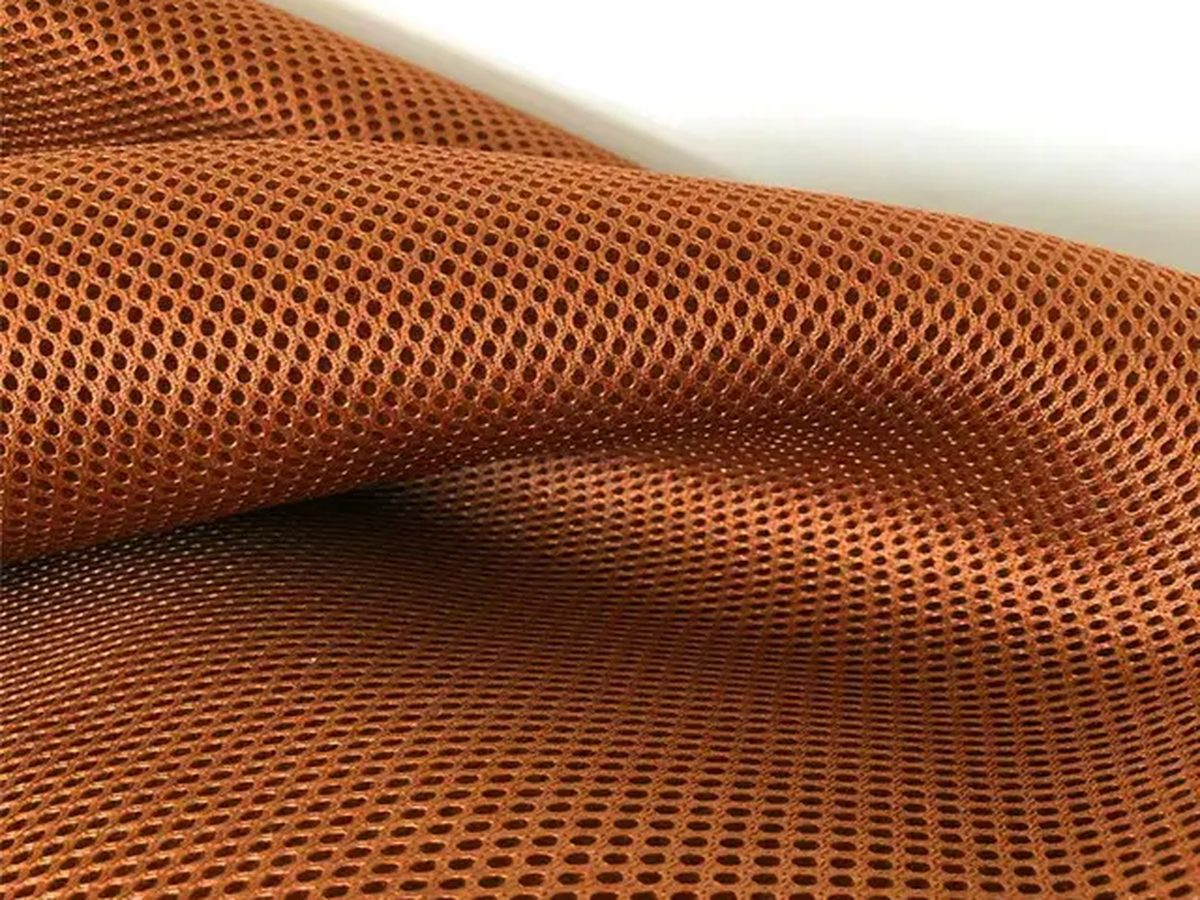
3. Snagging and pilling
What you see. Surface pulls into loops where bags rub or where Velcro touches.
Why it happens. Long float yarns on the face; loose stitch density.
How to catch it before you order. ISO 12945-2 Martindale pilling, 2000 rubs, plus a manual Velcro rub test.
What to specify instead. Choose tricot face, tighter stitch density, and specify a snag-resistant yarn for strap contact zones.
4. Odour after washing
What you see. A sour smell persists after drying, worst in humid climates.
Why it happens. Residual spinning oil trapped in the spacer gap; the gap dries slowly.
How to catch it before you order. Blind sniff panel after 3 wash-dry cycles at 40 C; ask for residual oil content.
What to specify instead. Require low-residual-oil yarn and a rinse after dyeing; specify quick-dry yarn for humid markets.
Building a test plan you will actually run
| Test | Method | Acceptance |
|---|---|---|
| Compression recovery | internal 5 kg / 24 h / 40 C | >= 90 % |
| Peel strength (laminated) | ISO 2411 | >= 6 N/50 mm |
| Pilling | ISO 12945-2 | >= grade 3-4 |
| Colour fastness to rubbing | ISO 105-X12 | >= grade 4 dry, >= 3-4 wet |
| Dimensional change | ISO 6330 / ISO 5077 | <= 3 % |
Five tests is enough for a first order. The point is not comprehensiveness, it is that the same five run on every lot, so a change becomes visible. A test nobody repeats is a story, not a control.
Run them on production material, not on a development sample. Ask for the report to carry the lot number and the date, and keep it with the shipment file. When a claim arrives two years later, that file is the difference between a discussion and a write-off.
What the report should contain
- The method, by standard number, not by description.
- The measured value, not only pass or fail. A marginal pass tells you where the risk sits.
- The sampling position: which roll, which metre, which batch.
- The conditioning before testing, because humidity changes several of these results.
- The laboratory name and the date, so the report can be traced.
Specification ranges for 3D mesh are on the product page. If a failure you are seeing is not covered here, send the batch details and photographs — we will tell you what we think caused it, including when the cause is upstream of the material.
Questions buyers ask before ordering
Can you supply 3D mesh under 200 m per colour?
We can, at a small-lot surcharge, because beam setup and dyeing are the fixed cost. Below 100 m we usually quote from stock shades instead of custom dyeing.
Does thickness tolerance matter?
Yes. +/- 0.5 mm is normal; +/- 1 mm changes the sewing allowance and the compression figure. Ask for the tolerance in writing.
Is 3D mesh machine washable?
Spacer knits tolerate 40 C domestic washing if the face is tricot and the edge is bound. Laminated versions depend on the adhesive, not the mesh.
Seven lines that turn a quotation into a specification
Most post-delivery arguments are not about quality. They are about a document that never said which figure would be measured, on which instrument, at whose cost.
- Weight (180-420 gsm): name the number, not the word. If the answer only repeats the band, ask which point inside it is being offered for this order.
- Compression recovery: >= 90 % is the market band. Fix the figure you will test at goods-in, and the instrument you will test it with.
- Air permeability (300-1200 L/m2/s): fix the value per shipment, and state who pays for the re-test if a lot lands outside it.
- Monofilament diameter: 0.08-0.20 mm is not an answer on its own. Ask for the last three lots’ actual readings and the spread behind them.
- Deviation rule: anything outside the agreed bands is reported before shipment, not after arrival.
- Packing and marking: shipping mark, roll or carton count and the tolerance on quantity, since a short shipment is a claim too.
- Who inspects: third-party, in-house or none, decided in advance, with the AQL level written down.
Three questions, and the answers that separate mills
If the claim you are handling is going to be decided on a call, take these three questions into it.
| Question | Answer that should worry you | Answer that holds up |
|---|---|---|
| Which test catches snagging and pilling? | “We have never had a complaint.” | Pilling — on the production lot, with the acceptance figure written into the report and not into the email. |
| May I see a report for a lot you shipped last month? | “That is confidential customer information.” | A redacted report, which carries every number that matters and none of the customer’s identity. |
| Where in the >= 90 % band will this order sit? | “In the middle, normally.” | A stated target and the readings behind it. Compression recovery drifting inside the band is how a conforming lot still fails. |
Dealing with a failure now, or trying to avoid one?
Send the end use, the quantity and the destination market, and we will come back with a specification that meets it, a price at your volume and the test reports that back it up. Samples are free for qualified programmes; we charge the courier only.
Related reading
- How to Test 3D Mesh Before You Commit to a Container
- Air permeability in 3D mesh fabric
- What 3D Mesh Really Costs
Sample cut with your values on it · Neutral packing and private label · Consolidation, documents and lead times