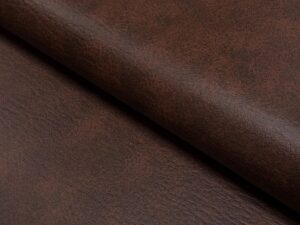
The purpose of a pre-shipment test is not to prove the material is good. It is to prove the material is the same as the one you approved, and to catch the change before it becomes a container.
The minimum set
| Test | Method | Acceptance |
|---|---|---|
| Peel strength | ISO 2411 | >= 6 N/50 mm |
| Hydrolysis (ageing) | 70 C / 95 % RH, 7 days | no tackiness, >= 80 % peel retained |
| Abrasion | ISO 12947-2 Martindale | >= 20 000 cycles |
| Cold flex | ISO 7854 / -20 C | >= 30 000 cycles |
| Colour fastness to rubbing | ISO 105-X12 | >= grade 4 |
| Tear strength | ISO 3377-1 | >= 20 N |

Why each test earns its place
Peel strength. Run to ISO 2411, acceptance >= 6 N/50 mm. This is the test that answers the question the buyer will ask first, and the one where a supplier is most likely to send a development sample rather than production material.
Hydrolysis (ageing). Run to 70 C / 95 % RH, 7 days, acceptance no tackiness, >= 80 % peel retained. This is the test that answers the question the buyer will ask first, and the one where a supplier is most likely to send a development sample rather than production material.
Abrasion. Run to ISO 12947-2 Martindale, acceptance >= 20 000 cycles. This is the test that answers the question the buyer will ask first, and the one where a supplier is most likely to send a development sample rather than production material.
Cold flex. Run to ISO 7854 / -20 C, acceptance >= 30 000 cycles. This is the test that answers the question the buyer will ask first, and the one where a supplier is most likely to send a development sample rather than production material.
Sampling for PU leather, and where it goes wrong
A single sample from the top of a roll tells you about the top of that roll. For a first order of PU leather, take three positions along the run and one sample per colour, then test peel strength on all of them rather than on a composite.
Condition the samples before testing. Several PU leather results move by 10-20 % between a dry laboratory and a humid one, which is why two labs can disagree on the same material without either being wrong.

Reading a PU leather report properly
- The measured value for peel strength, not only the verdict. A pass at >= 6 N/50 mm is a risk, not a comfort.
- The method number for hydrolysis (ageing), not the description. A trade name is not a method.
- Conditioning and duration, because both change several results in this family.
- Sampling position and lot number, so the result can be tied to the cartons you received.
- The laboratory name and its accreditation, if the report may be used in a dispute.
The three tests buyers skip and regret
First, the test that reproduces the end use rather than the laboratory condition. For PU leather that usually means hydrolysis (ageing) measured after the wash or exposure the product will actually see, because hydrolysis does not appear in a conditioned laboratory.
Second, the test on the assembled product. Flat goods can pass every check and still fail at a seam, a fold or a fixing point. Peel failure at seams is usually a construction failure rather than a material one.
Third, retention. Keep one sealed sample per approved lot, labelled with the lot number and the date, for at least two years. It is the only way to know whether peel strength changed or the conditions did.

Turning test results into a purchase order clause
Write the acceptance value into the PO, name the method, and state what happens on failure: replacement, credit, or rejection at whose cost. A test without a consequence is advisory, and advisory tests get skipped when the schedule is tight.
Full parameter ranges are on the PU leather page; the checks that hold those ranges in production are described on the quality control page.
Questions buyers ask before ordering
What is the difference between hydrolysis-resistant and standard PU?
Standard ester-based PU absorbs moisture and breaks down from the inside. Hydrolysis-resistant grades use a different polyol and survive years in humid conditions. Ask for the 70 C / 95 % RH report.
Can PU leather be sewn like real leather?
Yes, with a leather needle, longer stitch and a roller foot. The risk is seam slippage on non-woven backing, so specify knitted or woven for sewn goods.
Is 1.0 mm a real thickness or a nominal one?
Always ask. +/- 0.05 mm is a real tolerance; some suppliers quote 1.0 mm for 0.85 mm goods.
How often to re-test
| Stage | What to test | Frequency |
|---|---|---|
| Development sample | All parameters in the specification | Once per development |
| First production lot | All parameters, plus the end-use test | Every lot for the first three |
| Repeat lots | Critical parameters and the one that failed before | Every lot |
| Annual | Full panel, including ageing where relevant | Once a year, or after any process change |
The rule behind the table is simple: test most when you know least. A supplier with three clean lots has earned a lighter regime; a supplier with a process change has not, even after five years.
Retained samples: the cheapest insurance in the order
Keep one sealed sample per approved lot, labelled with the lot number and the date, for at least two years. It costs a shelf. It is also the only way to answer the question that decides most claims: did the material change, or did the conditions?
Without a retained sample, a claim becomes an argument about memory. With one, it becomes a measurement, and measurements get resolved.
For PU leather, the sample should include the finish, not just the base material, because hydrolysis usually starts in the finish or the additive rather than the substrate.
The test plan for PU leather, by order size
| Order | Tests to run | What it establishes |
|---|---|---|
| Sample or trial | Peel strength | Whether the material can meet the requirement at all |
| First production order | Peel strength, Hydrolysis (ageing), Abrasion | The baseline every later lot is compared against |
| Repeat orders | Peel strength plus the parameter that failed last time | Whether the process has drifted |
| Annual or after a process change | Full panel | That nothing has moved in the background |
Testing more on a repeat order is waste; testing less on a first order is a gamble. The table is deliberately asymmetric, because the risk is. For PU leather, the one test never worth dropping is peel strength, because it is the one that predicts hydrolysis.
From quotation to specification in seven lines
Leave the tolerance and the method out and every dispute is settled by whoever needs the goods more.
- Abrasion: the figure you will accept inside the >= 20 000 Martindale cycles band, the tolerance on it, and the method used to measure it.
- Cold flex (-20 C, 30 000 cycles): name the number, not the word. If the answer only repeats the band, ask which point inside it is being offered for this order.
- Surface finish: release paper / cast / embossed is the market band. Fix the figure you will test at goods-in, and the instrument you will test it with.
- Colour fastness to rubbing (>= grade 4): fix the value per shipment, and state who pays for the re-test if a lot lands outside it.
- Sample retention: one production sample per lot stays with the mill for twelve months. Claims are settled against it, not against memory.
- Test reports: name the standard as well as the test. A pass on a development sample is not a pass on a production lot.
- Deviation rule: anything outside the agreed bands is reported before shipment, not after arrival.
Questions worth asking before the price is agreed
The questions below are the ones that cannot be answered from a catalogue, which is exactly why they are worth asking.
| Question | Answer that should worry you | Answer that holds up |
|---|---|---|
| Who signs the test report, and against which standard? | “Our QC department signs it.” | A named standard, a named method and a signature that belongs to somebody who can be asked again next year. |
| How do you hold cold flex at -20 C, 30 000 cycles? | “That is standard for us, no problem.” | The last three lots’ readings, the instrument used and who signs the report. Peel failure at seams starts here. |
| What happens if colour fastness to rubbing misses the >= grade 4 requirement? | “It will not happen.” | A re-test clause, the tolerance on the re-test, and the point at which the lot is remade rather than discounted. |
Need a test plan for a first order?
Send the end use, the quantity and the destination market, and we will come back with a specification that meets it, a price at your volume and the test reports that back it up. Samples are free for qualified programmes; we charge the courier only.
Related reading
Sample cut with your values on it · Neutral packing and private label · Consolidation, documents and lead times