Buyers lose money on 3d mesh fabric in a predictable way: they specify one figure tightly and leave the rest to the supplier. This is a walk through every figure that changes the outcome, in the order it matters.
Why the headline number is the least useful one
Every quotation leads with thickness. It is easy to compare and it is the number the factory can hit most cheaply. But it tells you almost nothing on its own: thickness sets the frame, and the parameters below set whether the product survives its first year in service. A buyer who compares only the headline figure is buying a sample, not a supply agreement.
For 3D mesh, the practical rule is to fix the headline figure at the level your product needs and then spend your negotiating attention on compression recovery and air permeability. Those two are where cheap goods differ from adequate goods, and they are usually absent from the quotation sheet.

The numbers that decide performance
| Parameter | Typical range | What it changes |
|---|---|---|
| Thickness | 3-15 mm | Cushioning and airflow. Above 8 mm cutting, edge binding and sewing all get harder and reject rates rise. |
| Weight | 180-420 gsm | Durability and cost. Under 220 gsm in seating, expect compression set within a season. |
| Compression recovery | >= 90 % | The single best predictor of whether a seat still looks new after a year of use. |
| Air permeability | 300-1200 L/m2/s | Breathability claim. A dense surface layer can halve this without changing thickness. |
| Monofilament diameter | 0.08-0.20 mm | Sets the resilience of the gap. Thin monofilament feels soft and collapses early. |
| Usable width | 150-160 cm | Affects cutting yield on bag panels and chair covers more than price per metre does. |
| Surface construction | tricot / plain / mesh | Tricot resists snagging; open mesh looks technical but catches on Velcro and zips. |
| Colour fastness to rubbing | >= grade 4 | Dark shades on light foam show crocking at fold lines after packing. |
Read the table as a set of trade-offs rather than a checklist. Moving any single line usually costs money somewhere else, and the cheapest way to hit one figure is often to let another slip.
Thickness
Typical range: 3-15 mm. Cushioning and airflow. Above 8 mm cutting, edge binding and sewing all get harder and reject rates rise.
Weight
Typical range: 180-420 gsm. Durability and cost. Under 220 gsm in seating, expect compression set within a season.
Compression recovery
Typical range: >= 90 %. The single best predictor of whether a seat still looks new after a year of use.
Air permeability
Typical range: 300-1200 L/m2/s. Breathability claim. A dense surface layer can halve this without changing thickness.
Monofilament diameter
Typical range: 0.08-0.20 mm. Sets the resilience of the gap. Thin monofilament feels soft and collapses early.
How to write a 3D mesh specification that protects you
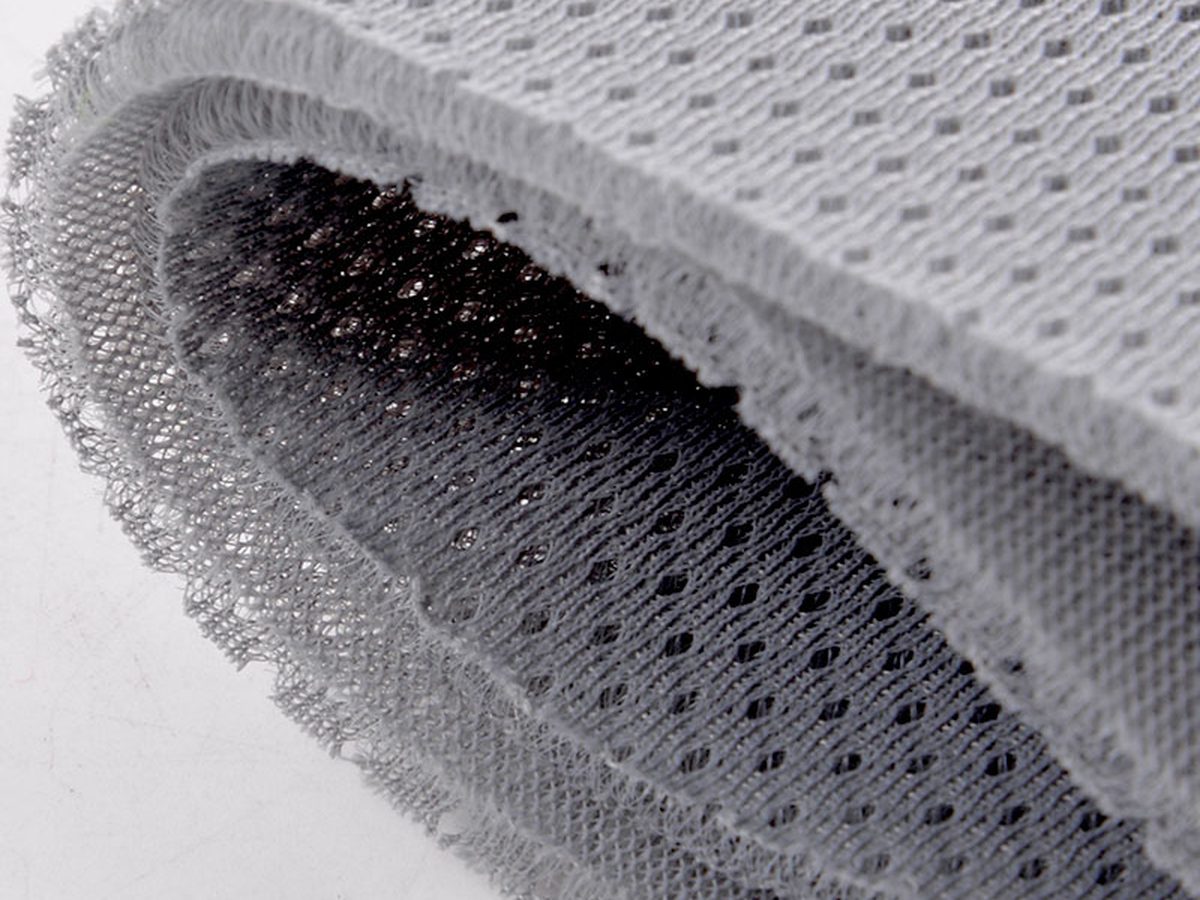
A specification is only useful if a substitution becomes visible. That means writing the construction and the performance together, and naming the test that proves each one. For 3D mesh, the clause has to pin compression recovery and air permeability, because those two separate a compliant lot from an adequate one:
3D spacer mesh, 100 % polyester, 6 mm, 320 gsm, 155 cm usable, compression recovery >= 90 %, laminated to 2 mm PU foam with hot-melt adhesive, Pantone 19-4013 TCX
Note what is missing from that line: adjectives. No ‘high quality’, no ‘premium’, no ‘export grade’. Every clause is either a number with a tolerance or a named test. If a supplier cannot quote against a line written this way, that is information about the supplier.
Where the specification usually breaks down
The first failure is compression set. Seat pads flatten in the first months; foam looks tired while the cover is intact. The cause is usually monofilament too thin or density too low for the load, or the wrong polymer for the climate. The test that exposes it before you order: Load a 100 mm square with 5 kg at 40 C for 24 h, release, measure recovery after 30 min.
The second is delamination. Mesh separates from foam or backing after washing or dry cleaning. It comes from flame lamination is cheap and fails at the adhesive line under heat and solvent. Test with ISO 2411 peel strength on a 50 mm strip, before and after one wash cycle. and write the result into the purchase order, not just the enquiry.
Both failures share a pattern: they appear months after delivery, they are hard to attribute, and the cost lands on the buyer rather than the mill. That is exactly why the test belongs in the specification and the report belongs in the shipment file.
What to put in a 3D mesh enquiry
- End use and the conditions, which together decide where compression recovery has to sit inside >= 90 %.
- The one figure that must hold, with compression recovery named as the proof.
- Quantity per colour and per delivery, against a typical MOQ of 300-500 m per colour.
- Destination market, because compliance changes the construction, not just the paperwork.
- A physical standard viewed under a stated light source, not a screen proof.
With those five points we can quote against a real requirement instead of a generic range. Full ranges sit on the 3D mesh page, and the manufacturing side of the same question is on our quality control page.

Questions buyers ask before ordering
Can you supply 3D mesh under 200 m per colour?
We can, at a small-lot surcharge, because beam setup and dyeing are the fixed cost. Below 100 m we usually quote from stock shades instead of custom dyeing.
Does thickness tolerance matter?
Yes. +/- 0.5 mm is normal; +/- 1 mm changes the sewing allowance and the compression figure. Ask for the tolerance in writing.
Is 3D mesh machine washable?
Spacer knits tolerate 40 C domestic washing if the face is tricot and the edge is bound. Laminated versions depend on the adhesive, not the mesh.
Failure modes worth a clause in the purchase order
Claims rarely come from a batch that was obviously wrong. They come from a thickness figure that sat inside the quoted band and outside what the product needed.
| Failure | What triggers it | Test to demand on the production lot |
|---|---|---|
| Compression set | Monofilament too thin or density too low for the load, or the wrong polymer for the climate. | Compression recovery — internal 5 kg / 24 h / 40 C; acceptance >= 90 % |
| Delamination | Flame lamination is cheap and fails at the adhesive line under heat and solvent. | Peel strength (laminated) — ISO 2411; acceptance >= 6 N/50 mm |
The other two, with acceptance numbers attached, are in the full failure analysis for 3D mesh. A supplier who cannot name the mode he sees most often is describing a catalogue, not a process.
Seven lines that turn a quotation into a specification
Most post-delivery arguments are not about quality. They are about a document that never said which figure would be measured, on which instrument, at whose cost.
- Weight (180-420 gsm): name the number, not the word. If the answer only repeats the band, ask which point inside it is being offered for this order.
- Compression recovery: >= 90 % is the market band. Fix the figure you will test at goods-in, and the instrument you will test it with.
- Air permeability (300-1200 L/m2/s): fix the value per shipment, and state who pays for the re-test if a lot lands outside it.
- Monofilament diameter: 0.08-0.20 mm is not an answer on its own. Ask for the last three lots’ actual readings and the spread behind them.
- Deviation rule: anything outside the agreed bands is reported before shipment, not after arrival.
- Packing and marking: shipping mark, roll or carton count and the tolerance on quantity, since a short shipment is a claim too.
- Who inspects: third-party, in-house or none, decided in advance, with the AQL level written down.
Need this specified against your end use?
Send the end use, the quantity and the destination market, and we will come back with a specification that meets it, a price at your volume and the test reports that back it up. Samples are free for qualified programmes; we charge the courier only.
Related reading
Sample cut with your values on it · Neutral packing and private label · Consolidation, documents and lead times