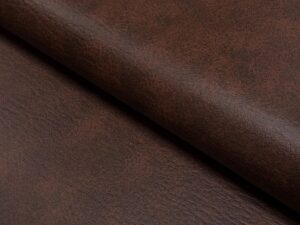
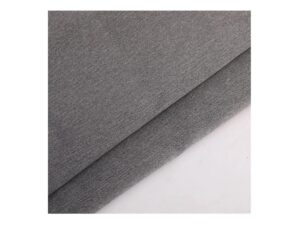
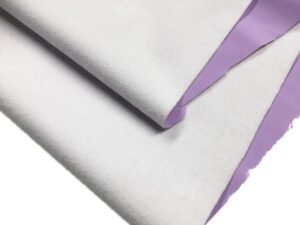
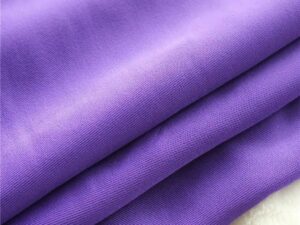
The comparison only means something once you fix the number of use cycles.
The decision in one paragraph
Non-woven fabric and Knitted fabric are not substitutes in the way a price list suggests. non-woven is specified for tensile strength at MD 20-60 N/5 cm; knitted fabric is specified for weight at 120-320 gsm. If your product depends on the first, the second is a compromise regardless of price.
One is a web, the other is a loop. The web has no grain to distort and no edge to fray, which is why it wins in converting and loses in drape.
Cost per use is the only comparison that holds across both, and it requires a cycle count that most buyers do not have.

Side by side on the numbers that matter
| non-woven | knitted fabric | Comparison |
|---|---|---|
| Primary use | Bags and packaging | T-shirts and basics |
| Decisive parameter | Tensile strength: MD 20-60 N/5 cm | Weight: 120-320 gsm |
| Second parameter | Elongation: 20-80 % | Stitch length: 2.6-3.4 mm |
| Usual MOQ | 1000-2000 kg per colour | 500-800 kg per colour |
| Production lead time | 15-20 days | 20-30 days |
| Characteristic failure | Low CD strength | Skew / torque |
Where non-woven wins
Direction matters: CD strength is usually half of MD and fails first. Low elongation is brittle; high elongation bags out.
The failure you are buying protection against is low cd strength: material tears across the roll when pulled or sewn. If that is the failure your customer will report, non-woven is the cheaper decision even at a higher unit price.

Where knitted fabric wins
Apparel hand and opacity. Tolerance of +/- 5 % is normal, +/- 10 % is a claim waiting to happen. Looser stitch is softer and pills faster; tighter is firmer and heavier.
Against that, knitted fabric fails as skew / torque. Side seams spiral after washing, garments twist on the body. The question is whether your programme can absorb that failure, and whether the saving per unit exceeds the cost of one occurrence.
How to decide without a trial order
- Write the service conditions for the end product, including washing and climate.
- Name the failure you cannot accept, in one sentence.
- Ask both suppliers for the same test on that failure, on production material.
- Compare landed cost including the expected claim rate, not unit price.
- Record the decision and the reason, so a cheaper quote later does not reopen it.
Specifications for both are on the non-woven page and the knitted fabric page. If you send the end product description, we will tell you which one we would specify and what we would test first.

Questions buyers ask before ordering
Do you quote MD and CD strength?
Yes, and you should insist on it. A single tensile figure usually means MD only, which hides the direction that fails.
Can you match a Pantone colour on cotton jersey?
Within dE <= 1.0 on most shades. Very bright greens and some blues are outside the reactive gamut; we will tell you before sampling rather than after.
Total cost over three years
| Line | non-woven | knitted fabric | Note |
|---|---|---|---|
| Purchase | Higher unit price | Lower unit price | Paid at the order |
| Claims | Lower if the spec matches | Higher if the failure mode hits | Paid 6-18 months later |
| Replacement | Rare | Likely once | Paid in the season you cannot supply |
| Rework at your factory | Lower | Higher if the material behaves differently | Paid in labour |
The two materials fail in different places, and that is the deciding factor. non-woven fails as low cd strength; knitted fabric fails as skew / torque. Choose the failure you can detect early, because an early failure is a rework and a late one is a claim.
A trial that answers the question in one container
- Take production samples of both, in the exact construction you would order.
- Run the end-use process: print, strength, cost.
- Test the single failure you cannot accept, on both, with the same method.
- Put the result next to the landed cost including the expected claim rate.
The specification to send, for either
Whichever way you decide, send the same line to both suppliers so the quotes are comparable. For non-woven:
Polypropylene spunbond, 80 gsm +/- 5 %, 160 cm, MD tensile >= 30 N/5 cm, CD >= 18 N/5 cm, UV stabilised, Pantone 19-3906 TCX
And for knitted fabric:
Single jersey, 100 % combed cotton, 180 gsm +/- 5 %, open width 175 cm, stitch length 2.9 mm, shrinkage <= 5 % after 3 washes, skew <= 5 %, reactive dyed, Pantone 19-1664 TCX
Where both appear in the same product
Most assembled products use both materials rather than choosing one. non-woven typically carries bags and packaging, while knitted fabric carries t-shirts and basics. The decision is therefore not which one to buy but which one to put where the load and the wear are.
A practical rule: put non-woven at the point where low cd strength would be expensive to fix, and knitted fabric where skew / torque is visible early enough to rework. That single sentence resolves most specification arguments between the two.
Three questions to ask both suppliers
- Which parameter would you change to hit a lower price, and what does it cost? The answer shows whether the supplier understands their own trade-offs.
- What is the MOQ per colour, and what does a repeat order need? non-woven typically runs 1000-2000 kg per colour; knitted fabric runs 500-800 kg per colour.
- What would you refuse to guarantee, and why? A supplier with no limits is either new or not answering.
Failure modes worth a clause in the purchase order
Claims rarely come from a batch that was obviously wrong. They come from a process figure that sat inside the quoted band and outside what the product needed.
| Failure | What triggers it | Test to demand on the production lot |
|---|---|---|
| Weight shortfall | Nominal gsm quoted from the line setting, not the delivered goods. | Mass per unit area — ISO 9073-1; acceptance +/- 5 % of nominal |
| Colour lot variation | Surface dyeing at low gsm; poor bath control. | Tensile strength — ISO 9073-3; acceptance MD >= 20 N/5 cm, CD >= 12 N/5 cm |
The other two, with acceptance numbers attached, are in the full failure analysis for non-woven. A supplier who cannot name the mode he sees most often is describing a catalogue, not a process.
Seven lines that turn a quotation into a specification
Most post-delivery arguments are not about quality. They are about a document that never said which figure would be measured, on which instrument, at whose cost.
- Weight (15-200 gsm): name the number, not the word. If the answer only repeats the band, ask which point inside it is being offered for this order.
- Tensile strength: MD 20-60 N/5 cm is the market band. Fix the figure you will test at goods-in, and the instrument you will test it with.
- Elongation (20-80 %): fix the value per shipment, and state who pays for the re-test if a lot lands outside it.
- Width: 160-320 cm is not an answer on its own. Ask for the last three lots’ actual readings and the spread behind them.
- Deviation rule: anything outside the agreed bands is reported before shipment, not after arrival.
- Packing and marking: shipping mark, roll or carton count and the tolerance on quantity, since a short shipment is a claim too.
- Who inspects: third-party, in-house or none, decided in advance, with the AQL level written down.
Choosing between these two for a live programme?
Send the end use, the quantity and the destination market, and we will come back with a specification that meets it, a price at your volume and the test reports that back it up. Samples are free for qualified programmes; we charge the courier only.
Related reading
Sample cut with your values on it · Neutral packing and private label · Consolidation, documents and lead times