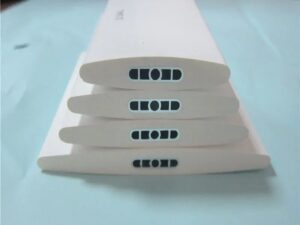
The density figure gets specified to two decimal places; slat thickness at 2.5-3.2 mm is the one that decides whether the lot is usable.
Paulownia: why the headline number is the least useful one
Every quotation leads with density. But it tells you almost nothing on its own: density sets the frame, and the parameters below set whether the product survives its first year in service.
For paulownia, the practical rule is to fix the headline figure at the level your product needs and then spend your negotiating attention on slat thickness and moisture content.

The paulownia numbers that decide performance
| Parameter | Typical range | What it changes | Density | 0.25-0.32 g/cm3 | 40 % lighter than basswood, which cuts freight per set substantially. | Slat width | 25 / 35 / 50 mm | 63 mm is possible but the material is soft for that span. | Slat thickness | 2.5-3.2 mm | Needs more thickness than basswood to reach the same stiffness. | Moisture content | 8-12 % | Paulownia moves faster than basswood, so equalising matters more, not less. | Grain | straight, coarse pores | Coarse pores drink lacquer, so sealing coats are heavier. | Coating | 3-4 coats, sanding sealer first | Skipping the sealer produces a patchy finish. | Hardness | low (about 1.5-2.0 kN Janka) | Dents under impact; not for high-traffic contract use. | Warp tolerance | <= 2.0 mm per 1 m | Slightly looser than basswood because the material is less stable. |
|---|
Density
Typical range: 0.25-0.32 g/cm3. 40 % lighter than basswood, which cuts freight per set substantially.
Slat width
Typical range: 25 / 35 / 50 mm. 63 mm is possible but the material is soft for that span.
Slat thickness
Typical range: 2.5-3.2 mm. Needs more thickness than basswood to reach the same stiffness.
Moisture content
Typical range: 8-12 %. Paulownia moves faster than basswood, so equalising matters more, not less.
Grain
Typical range: straight, coarse pores. Coarse pores drink lacquer, so sealing coats are heavier.
Density: range, tolerance and the clause
For Paulownia blinds and slats, the working range is 0.25-0.32 g/cm3.

What 0.25-0.32 g/cm3 does not tell you
| Position | Value | Effect on paulownia | Where it shows up | Floor | 0.25 | Lowest cost, least margin for process variation.25-0.32 g/cm3 | Denting within a season | Working middle | 0.25-0.32 g/cm3 | Predictable performance at a normal price.25-0.32 g/cm3 | Nothing to negotiate, nothing to explain.25-0.32 g/cm3 | Ceiling | 0.32 g/cm3 | Best performance, highest cost.25-0.32 g/cm3 | Cost the end product may not recover.25-0.32 g/cm3 |
|---|
The figure that decides the outcome is not density itself but the tolerance around it. A supplier who quotes 0.25-0.32 g/cm3 without a tolerance has not quoted a specification, and the first lot will define the tolerance for you.
How to measure density
The reference method here is Moisture content, run to oven-dry / pin meter, with an acceptance of 9-11 %.
A marginal pass on density tells you the process is running at the edge, which is the information you need before the next lot rather than after it.
The clause to write for density
Density appears with a tolerance and a test, not as a standalone number.
Paulownia venetian blind, 50 mm slat, 2.8 mm, density 0.25-0.32 g/cm3, moisture 9-11 %, sanding sealer + 3 coats, warp <= 2.0 mm/m, cordless to EN 13120
Grain: range, tolerance and the clause
For Paulownia blinds and slats, the working range is straight, coarse pores.

What straight, coarse pores does not tell you
| Position | Value | Effect on paulownia | Where it shows up | Floor | straight, coarse pores | Lowest cost, least margin for process variation.25-0.32 g/cm3 | Denting within a season | Working middle | straight, coarse pores | Predictable performance at a normal price.25-0.32 g/cm3 | Nothing to negotiate, nothing to explain.25-0.32 g/cm3 | Ceiling | straight, coarse pores | Best performance, highest cost.25-0.32 g/cm3 | Cost the end product may not recover.25-0.32 g/cm3 |
|---|
The figure that decides the outcome is not grain itself but the tolerance around it. A supplier who quotes straight, coarse pores without a tolerance has not quoted a specification, and the first lot will define the tolerance for you.
How to measure grain
The reference method here is Janka hardness, run to ASTM D143, with an acceptance of report value.
For grain, two instruments that both claim the same standard can differ by enough to move a marginal lot from pass to fail.
A marginal pass on grain tells you the process is running at the edge, which is the information you need before the next lot rather than after it.
The clause to write for grain
Grain appears with a tolerance and a test, not as a standalone number.
Slat thickness: range, tolerance and the clause
For Paulownia blinds and slats, the working range is 2.5-3.2 mm.

What 2.5-3.2 mm does not tell you
| Position | Value | Effect on paulownia | Where it shows up | Floor | 2.5 | Lowest cost, least margin for process variation.25-0.32 g/cm3 | Patchy finish within a season | Working middle | 2.5-3.2 mm | Predictable performance at a normal price.25-0.32 g/cm3 | Nothing to negotiate, nothing to explain.25-0.32 g/cm3 | Ceiling | 3.2 mm | Best performance, highest cost.25-0.32 g/cm3 | Cost the end product may not recover.25-0.32 g/cm3 |
|---|
The figure that decides the outcome is not slat thickness itself but the tolerance around it. A supplier who quotes 2.5-3.2 mm without a tolerance has not quoted a specification, and the first lot will define the tolerance for you.
How to measure slat thickness
The reference method here is Warp, run to 48 h at 23 C / 50 % RH, with an acceptance of <= 2.0 mm per 1 m.
For slat thickness, two instruments that both claim the same standard can differ by enough to move a marginal lot from pass to fail.
A marginal pass on slat thickness tells you the process is running at the edge, which is the information you need before the next lot rather than after it.
The clause to write for slat thickness
Slat thickness appears with a tolerance and a test, not as a standalone number.
Moisture content: range, tolerance and the clause
For Paulownia blinds and slats, the working range is 8-12 %.

What 8-12 % does not tell you
| Position | Value | Effect on paulownia | Where it shows up | Floor | 8 | Lowest cost, least margin for process variation.25-0.32 g/cm3 | Colour variation within a season | Working middle | 8-12 % | Predictable performance at a normal price.25-0.32 g/cm3 | Nothing to negotiate, nothing to explain.25-0.32 g/cm3 | Ceiling | 12 % | Best performance, highest cost.25-0.32 g/cm3 | Cost the end product may not recover.25-0.32 g/cm3 |
|---|
The figure that decides the outcome is not moisture content itself but the tolerance around it. A supplier who quotes 8-12 % without a tolerance has not quoted a specification, and the first lot will define the tolerance for you.
How to measure moisture content
The reference method here is Coating adhesion, run to cross-hatch, with an acceptance of no lift.
A marginal pass on moisture content tells you the process is running at the edge, which is the information you need before the next lot rather than after it.
The clause to write for moisture content
Moisture content appears with a tolerance and a test, not as a standalone number.
Slat width on paulownia: range, tolerance and the clause
For Paulownia blinds and slats, the working range is 25 / 35 / 50 mm.

How to choose a slat width option on paulownia
| Option | What it changes in paulownia | When it is the right choice | 25 | Warping is where it usually ends up. | Cost-led programmes with a short service life.25-0.32 g/cm3 | 35 | The volume middle: enough margin for process variation without paying for headroom the end product cannot use.25-0.32 g/cm3 | Most repeat programmes, and the safest default.25-0.32 g/cm3 | 50 mm | The top of the family, where the process is controlled tightly enough to guarantee it.25-0.32 g/cm3 | A warranty, a tender, or a specification that cannot be renegotiated.25-0.32 g/cm3 |
|---|
Slat width is chosen by the application rather than by price, and a supplier who quotes one option as if it were interchangeable with another is quoting a different product.
The figure that decides the outcome is not slat width itself but the tolerance around it. A supplier who quotes 25 / 35 / 50 mm without a tolerance has not quoted a specification, and the first lot will define the tolerance for you.
How to measure slat width on paulownia
The reference method here is Density, run to ISO 3131, with an acceptance of 0.25-0.32 g/cm3.
A marginal pass on slat width tells you the process is running at the edge, which is the information you need before the next lot rather than after it.
The clause to write for slat width on paulownia
Slat width appears with a tolerance and a test, not as a standalone number.
How to write a paulownia specification that protects you
For paulownia, the clause has to pin slat thickness and moisture content, because those two separate a compliant lot from an adequate one:
Paulownia venetian blind, 50 mm slat, 2.8 mm, density 0.25-0.32 g/cm3, moisture 9-11 %, sanding sealer + 3 coats, warp <= 2.0 mm/m, cordless to EN 13120

Paulownia: where the specification usually breaks down
The first failure is denting. Slats show dents and marks after a season of cleaning and use. The cause is usually low density and a soft early-wood layer. The test that exposes it before you order: Janka hardness and a drop test with a 50 g ball from 30 cm.
The second is warping. Slats cup or bow, faster than basswood in the same room. It comes from high moisture variation and a porous structure that absorbs quickly. Test with 48 h at 23 C / 50 % RH, then measure.
What to put in a paulownia enquiry
- End use and the conditions, which together decide where slat thickness has to sit inside 2.5-3.2 mm.
- The one figure that must hold, with moisture content named as the proof.
- Quantity per colour and per delivery, against a typical MOQ of 300-500 sets per colour.
- Destination market, because compliance changes the construction, not just the paperwork On paulownia that is density at 0.25-0.32 g/cm3.
- A physical standard viewed under a stated light source, not a screen proof For paulownia slats it is slat thickness at 2.5-3.2 mm that settles it.
Full ranges sit on the paulownia page, and the manufacturing side of the same question is on our quality control page.
Questions buyers ask before ordering
Can you hold tolerance at 40 % for paulownia specification explained on a repeat order?
On paulownia specification explained, capacity on tolerance is 40 %.
What drives the price of paulownia specification explained at tolerance of 40 %?
On paulownia specification explained, tolerance sits at 40 % for this construction.
Is 40 % achievable at our volume on paulownia specification explained?
On paulownia specification explained, the figure for tolerance is 40 %, measured at pre-shipment and written on the lot record rather than the brochure.
Paulownia: failure modes worth a clause in the purchase order
| Failure | What triggers it | Test to demand on the production lot | Denting | Low density and a soft early-wood layer. | Moisture content — oven-dry / pin meter; acceptance 9-11 % | Warping | High moisture variation and a porous structure that absorbs quickly.25-0.32 g/cm3 | Density — ISO 3131; acceptance 0.25-0.32 g/cm3.25-0.32 g/cm3 |
|---|
The other two, with acceptance numbers attached, are in the full failure analysis for paulownia.
Building a paulownia specification?
Send what you have — density, slat thickness, target market. We reply with the band we would hold and the two parameters we would test before the first bulk run.
Products in this range
Related reading
- Finished venetian blinds Specification: What Each Number Actually Changes
- How to Document a Quality Claim So It Gets Resolved
- Oxford Fabric Specification Guide: D Number, Coating and Waterproof Rating
Catalogue and current price list · Neutral packing and private label · Consolidation, documents and lead times