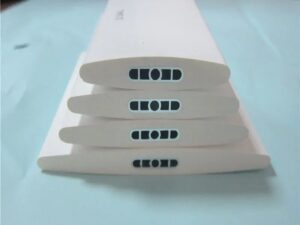
Slats are 80% of a wooden blind’s cost and 100% of its complaints. Warping, bowing and mismatched slat widths all trace back to three numbers: species, moisture content and machining tolerance.
Basswood vs paulownia
| Basswood | Paulownia | |
|---|---|---|
| Density | 370-420 kg/m³ | 280-320 kg/m³ |
| Weight per blind | Heavier | Around 20-25% lighter |
| Stability | Very stable, holds stain evenly | Stable, softer surface |
| Price | Higher | Lower |
| Best for | Premium retail, projects | Volume retail, wide windows |
Paulownia’s advantage is weight — on a 240 cm wide window, the lighter slat reduces headrail stress and cord wear. Basswood’s advantage is finish quality: it takes a stain more evenly, which matters if your customer compares two blinds side by side.
Moisture content: the number that decides everything
Wood shipped above 12% moisture arrives warped, because the container heats up and the wood dries unevenly in transit. Below 8% it becomes brittle and splits when the ladder cord is tensioned.
Ask for the moisture reading per batch, measured by pin meter on at least five slats per carton. A supplier who cannot produce that number is guessing.
What ±0.1 mm tolerance buys you
Slat width consistency determines whether the blind hangs square. At ±0.3 mm, a 50 mm slat can vary 0.6 mm across a blind — visible as a wavy bottom rail on a wide window. CNC machining at ±0.1 mm removes that variable, which is why we machine rather than buy finished slats.
Coating and colour
- Water-based lacquer, 3 coats — low odour, REACH-friendly, adequate for interior use.
- Stained + lacquered — deeper grain definition, more coats, higher cost.
- Raw sanded — for buyers who finish locally.
Twelve standard stains plus custom matching; send a physical sample rather than a photo, because stain on basswood and on paulownia read differently.
Specification template
Basswood slats, 50 mm width, 3.0 mm thickness, moisture 8-12%, tolerance ±0.1 mm, water-based lacquer 3 coats, colour [reference], FSC 100%, packed in shrink-wrapped bundles of 50. Send us this and we quote against it rather than against a price.
Full ranges are on the basswood slats and paulownia slats pages; loading volumes are on logistics.
Grading terms you will see on a quotation
Slat quotations often reference a grade: A grade (no visible knots, uniform colour), AB (occasional small pin knots, acceptable on stained finishes), B grade (visible knots and colour variation, for painted finishes only). A price that looks 15% low is usually AB or B grade quoted against an A-grade expectation.
How slat price is built
Species, slat width, thickness, grade, moisture treatment and lacquer coats. Wider slats consume more timber per metre and cost disproportionately more. Lacquer is the other lever: two coats versus three is a small price difference and a large difference in how the blind looks after two years in sunlight.
What to inspect on arrival
Open one carton per pallet and check: slat width consistency across ten slats, moisture with a pin meter, bow along a 2 m length against a straight edge, and stain uniformity under daylight. Five minutes per carton catches the batch problem before it reaches your customer.
Related guides
Ask for a slat sample set. We send basswood and paulownia in your chosen width and stain, so you can compare weight and finish before quoting your customer.
Catalogue and current price list · Neutral packing and private label · Consolidation, documents and lead times