In non-contract hospitality overflow, paulownia is judged on density at 0.25-0.32 g/cm3; the same article fails there and passes in a different product.
What non-contract hospitality overflow demands

Where the application changes the paulownia
| Application | What dominates | Starting specification | Value residential windows | Light weight, low price | 50 mm, 2.8 mm, 2-coat plus sealer | Wide windows | Weight matters for the headrail | 50 mm, reinforced cord holes | Rental and refurbishment | Cost per set dominates | 25 mm or 35 mm, stock stain | Temporary and event interiors | Short service life acceptable | 35 mm, light finish | Export markets with freight sensitivity | Freight per set is the driver | 50 mm, compressed cartons | Non-contract hospitality overflow | Cheap secondary rooms | 35 mm, standard stain |
|---|
Paulownia: the two parameters that matter most here
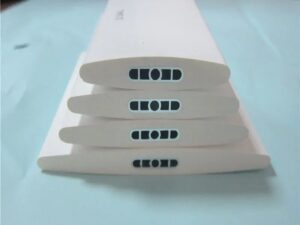
For this use, slat thickness is decisive because needs more thickness than basswood to reach the same stiffness.
The second is moisture content.

Paulownia: failure patterns specific to this use
Denting
The cause is low density and a soft early-wood layer. Test with Janka hardness and a drop test with a 50 g ball from 30 cm. and specify: Use paulownia for residential and low-traffic use; specify basswood or PVC for contract.
Warping
The cause is high moisture variation and a porous structure that absorbs quickly. Test with 48 h at 23 C / 50 % RH, then measure. and specify: Stricter drying to 9-11 % and moisture-barrier packing.
Paulownia: specifying for the application, not the catalogue
- Density 0.25-0.32 g/cm3 — measured at three positions on the roll, recorded as a number rather than pass or fail On paulownia that is density at 0.25-0.32 g/cm3.
- Slat thickness 2.5-3.2 mm — cut from the middle of the lot, not from the end of the roll For paulownia slats it is slat thickness at 2.5-3.2 mm that settles it.
- Moisture content 8-12 % — read at 23 C / 50 % RH after conditioning, not straight off the machine On paulownia, skipping this is what produces denting at the slat edge under impact.
- Warp tolerance 2.0 mm per metre — checked on production material, at in-process rather than only at pre-shipment For paulownia slats, the figure to write down is moisture content at 8-12 %.
- ISO 9424 for dimensions, ASTM D143 for hardness, EN 13501-1 for reaction to fire — run to the method named above; the report travels with the lot On paulownia that is density at 0.25-0.32 g/cm3.

Questions buyers ask before ordering
How do you verify tolerance against 50 mm on paulownia for non contract hospitality overflow?
On paulownia for non contract hospitality overflow, it depends on 50 mm and on the end use.
Does tolerance move between the paulownia for non contract hospitality overflow sample and bulk?
On paulownia for non contract hospitality overflow, not below 50 mm without a surcharge: the beam setup time does not shrink with the order, so small volumes carry the same setup.
What happens to paulownia for non contract hospitality overflow if we need tolerance tighter than 50 mm?
On paulownia for non contract hospitality overflow, the limit is 50 mm.
Paulownia: when the first specification fails, change this first
- Change the parameter, not the material. Moving slat thickness from the bottom of 2.5-3.2 mm to the middle fixes most failures at a fraction of the cost of a substitution.
- Change the finish or the additive. Denting is usually a finish problem; the substrate is often adequate.
- Change the construction. A seam, a fold or a fixing point fails before the material does in most assembled products For paulownia slats it is slat thickness at 2.5-3.2 mm that settles it.
- Change the material. Do this last, and take the whole programme through re-approval when you do On paulownia, skipping this is what produces denting at the slat edge under impact.
Paulownia: what the application will not forgive
Non-contract hospitality overflow has one requirement that cannot be traded against price: cheap secondary rooms.
Paulownia: failure modes worth a clause in the purchase order
| Failure | What triggers it | Test to demand on the production lot | Colour variation | Heartwood and sapwood mixed, or two species mixed under one name. | Moisture content — oven-dry / pin meter; acceptance 9-11 % | Denting | Low density and a soft early-wood layer. | Density — ISO 3131; acceptance 0.25-0.32 g/cm3.25-0.32 g/cm3 |
|---|
Writing the non-contract hospitality overflow order against paulownia
For non-contract hospitality overflow, three numbers on paulownia slats do most of the work, and none of them is the headline figure on the datasheet.
- Density: 0.25-0.32 g/cm3. Below the low end of that band on paulownia, denting at the slat edge under impact arrives early; above it, the paulownia price steps up without changing the failure rate.
- Slat thickness: 2.5-3.2 mm. This figure decides whether the paulownia survives a season of non-contract hospitality overflow rather than a single inspection.
- Moisture content: 8-12 %. Tightening moisture content is where a paulownia quotation gains its reputation and where most of the dispute cost is avoided in advance.
- Warp tolerance: 2.0 mm per metre on paulownia slats. Ask for that paulownia figure on the lot record, not on the sample card.
Write those four lines into the non-contract hospitality overflow order and two things change on paulownia: the supplier stops quoting the catalogue, and the arrival argument moves from “is it acceptable” to “does it match the line”. Only the second can be settled with a document, and only if density at 0.25-0.32 g/cm3 is on the paulownia order.
For non-contract hospitality overflow in paulownia slats, the inspection point matters as much as the figure. The density reading taken at goods-in is not the reading the user experiences, because denting at the slat edge under impact moves between the two.
What goes wrong first when paulownia reaches non-contract hospitality overflow
In non-contract hospitality overflow, the complaint that arrives first is denting at the slat edge under impact. It is the predictable result of density sitting at the bottom of 0.25-0.32 g/cm3 while everything else on the paulownia specification is met.
The mechanism on paulownia decides where you inspect it. Density is measured on the roll at 0.25-0.32 g/cm3; the user sees the same figure after a season in non-contract hospitality overflow, and the drop between them depends on density, which is not on most paulownia datasheets.
So the inspection that catches it is not the final one for paulownia. Take the density at 0.25-0.32 g/cm3 reading on paulownia slats at in-process, on production material, and record the number rather than pass or fail.
One line covers this on paulownia slats: density at 0.25-0.32 g/cm3, measured at in-process, recorded per lot. That is the whole difference between a paulownia claim and a conversation.
Packing and documents for non-contract hospitality overflow paulownia
The paulownia slats order is usually lost in the last three hundred metres, between the loading bay and the line. Three decisions carry it.
- Roll or pack format. paulownia travelling loose arrives with the outer laps crushed, and the first ten metres of every paulownia roll become waste. Specify a core and a paulownia carton height that stacks.
- Moisture, not weight. A container on a tropical route sweats, and denting at the slat edge under impact is what arrives three weeks later at 90 % RH. A desiccant bag per paulownia carton costs less than the paulownia claim.
- One paulownia slats document that names density. The invoice, the packing list and the inspection report should all quote density at 0.25-0.32 g/cm3; when they disagree, the broker delays the paulownia container.
At arrival, inspect the paulownia before you cut. The reading that matters for non-contract hospitality overflow is moisture content at 8-12 %, and it is cheapest to take on the roll, with the packing list in hand.
Retain one unopened paulownia carton per lot for thirty days — it is the only clean evidence if the denting at the slat edge under impact turns out to be transit damage rather than production.
Want a paulownia quotation you can compare line by line?
Tell us the slat thickness and the annual volume. The quotation comes back with the tolerance band, the MOQ per colour, and the test standard named against each figure.
Products in this range
Related reading
- Motorised blinds: Four Failures Buyers Report, and the Tests That Catch Them
- How to Vet a Textile and Window Covering Supplier: Twelve Questions That Reveal the Factory
- Venetian Blinds Import Guide: Carton Loading, Packaging and Landed Cost
Catalogue and current price list · Neutral packing and private label · Consolidation, documents and lead times