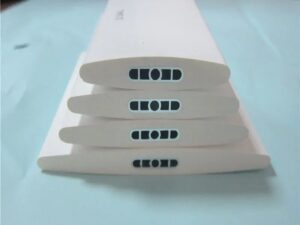
A pvc blinds and slats claim almost never arrives in the first month.
PVC: why failures cluster around one or two parameters
In PVC slats, the parameters in the table below are not independent. UV stabiliser and Yellowing resistance between them explain most field failures, and both are routinely omitted from quotations because they are expensive to guarantee and easy to leave vague.
| Parameter | Typical range | Why it decides failure | UV stabiliser | required, stated in phr | Without it, white goes yellow and colours fade within a season outdoors. | Yellowing resistance | QUV 300-500 h, dE <= 3 | The test that separates outdoor-grade from indoor-grade PVC. | Heat deflection | >= 65 C | Slats in a sun-facing window reach 60 C+ behind glass. | Colour | white / woodgrain / solid colours | Woodgrain is a film or co-extrusion; co-extrusion lasts longer. |
|---|

1. Yellowing
What you see. White slats turn cream within a year in a sunny window.
Why it happens. Insufficient or wrong UV stabiliser; often TiO2 grade rather than a true UV package.
QUV 300 h, measure dE and yellowing index.
What to specify instead. Specify the stabiliser system and require the QUV report; do not accept ‘UV treated’.
2. Heat warping
Why it happens. Heat deflection temperature below the in-window temperature.
Deflection test at 60 C for 4 h under load.
What to specify instead. Higher HDT formulation and a minimum 2.0 mm wall.

3. Cold brittleness
What you see. Slats crack when handled in an unheated warehouse in winter.
Why it happens. High filler content (calcium carbonate) to cut cost.
What to specify instead. Limit filler content and specify impact-modified compound for cold markets.
4. Woodgrain film peeling
Why it happens. Laminated film without adequate primer or edge sealing.
Cross-hatch plus 72 h at 40 C / 90 % RH.
What to specify instead. Co-extruded woodgrain for contract work; laminated film only for dry indoor use.

PVC: building a test plan you will actually run
| Test | Method | Acceptance | Yellowing | QUV 300 h | dE <= 3 | Heat deflection | ISO 75 / 60 C load test | no visible warp | Impact at low temperature | -10 C drop test | no crack | Colour fastness to light | ISO 105-B02 | >= grade 4 | Fire performance | EN 13501-1 | B-s1,d0 where specified |
|---|
PVC: what the report should contain
- Slat width 25, 35 or 50 mm — measured at three positions on the roll, recorded as a number rather than pass or fail On PVC that is slat width at 25, 35 or 50 mm.
- Thickness 1.8-2.5 mm — cut from the middle of the lot, not from the end of the roll For PVC slats it is thickness at 1.8-2.5 mm that settles it.
- Uv stabiliser stated in phr — read at 23 C / 50 % RH after conditioning, not straight off the machine On PVC, skipping this is what produces yellowing on a south-facing elevation.
- Heat deflection 65 C or better — checked on production material, at in-process rather than only at pre-shipment For PVC slats, the figure to write down is UV stabiliser at stated in phr.
- Warp tolerance 1.0 mm per metre at 60 C — stated in the purchase order with the test method beside it On PVC that is slat width at 25, 35 or 50 mm.
- ISO 4892-3 for QUV exposure, ISO 75-2 for heat deflection, EN 13501-1 for reaction to fire — run to the method named above; the report travels with the lot For PVC slats it is thickness at 1.8-2.5 mm that settles it.
Specification ranges for PVC slats are on the product page.
Questions buyers ask before ordering
What drives the price of failure modes and tests at tolerance of 2.0 mm?
On failure modes and tests, expect 2.0 mm.
Is 2.0 mm achievable at our volume on failure modes and tests?
On failure modes and tests, in practice 2.0 mm: that is what the slat machining holds without special setup, and it is what most repeat buyers accept once they have seen the batch record.
How do you verify tolerance against 2.0 mm on failure modes and tests?
On failure modes and tests, it depends on 2.0 mm and on the end use.
The test plan for PVC
The minimum set on PVC
| Test | Method | Acceptance | Yellowing | QUV 300 h | dE <= 3 | Heat deflection | ISO 75 / 60 C load test | no visible warp | Impact at low temperature | -10 C drop test | no crack | Colour fastness to light | ISO 105-B02 | >= grade 4 | Fire performance | EN 13501-1 | B-s1,d0 where specified | Lead and heavy metals | EN 71-3 / RoHS | below limit |
|---|

Sampling for PVC slats, and where it goes wrong
For a first order of PVC slats, take three positions along the run and one sample per colour, then test yellowing on all of them rather than on a composite.
Several PVC slats results move by 10-20 % between a dry laboratory and a humid one, which is why two labs can disagree on the same material without either being wrong.
Reading a PVC slats report properly
- Slat width 25, 35 or 50 mm — measured at three positions on the roll, recorded as a number rather than pass or fail On PVC, skipping this is what produces yellowing on a south-facing elevation.
- Thickness 1.8-2.5 mm — cut from the middle of the lot, not from the end of the roll For PVC slats, the figure to write down is UV stabiliser at stated in phr.
- Uv stabiliser stated in phr — read at 23 C / 50 % RH after conditioning, not straight off the machine On PVC that is slat width at 25, 35 or 50 mm.
- Heat deflection 65 C or better — checked on production material, at in-process rather than only at pre-shipment For PVC slats it is thickness at 1.8-2.5 mm that settles it.
- Warp tolerance 1.0 mm per metre at 60 C — stated in the purchase order with the test method beside it On PVC, skipping this is what produces yellowing on a south-facing elevation.
- ISO 4892-3 for QUV exposure, ISO 75-2 for heat deflection, EN 13501-1 for reaction to fire — run to the method named above; the report travels with the lot For PVC slats, the figure to write down is UV stabiliser at stated in phr.
The three tests buyers skip and regret on PVC
For PVC slats that usually means heat deflection measured after the wash or exposure the product will actually see, because yellowing does not appear in a conditioned laboratory.
Heat warping is usually a construction failure rather than a material one.
Third, retention. It is the only way to know whether uv stabiliser changed or the conditions did.
Turning test results into a purchase order clause on PVC
Full parameter ranges are on the PVC slats page; the checks that hold those ranges in production are described on the quality control page.
How often to re-test on PVC
| Stage | What to test | Frequency | Development sample | All parameters in the specification; measured on slat width, 25, 35 or 50 mm | Once per development | First production lot | All parameters, plus the end-use test; held at slat width, 25, 35 or 50 mm | Every lot for the first three; read against slat width, 25, 35 or 50 mm | Repeat lots | Critical parameters and the one that failed before; written as slat width 25, 35 or 50 mm | Every lot | Annual | Full panel, including ageing where relevant; measured on slat width, 25, 35 or 50 mm | Once a year, or after any process change; held at slat width, 25, 35 or 50 mm |
|---|
Retained samples: the cheapest insurance in the order on PVC
For PVC slats, the sample should include the finish, not just the base material, because yellowing usually starts in the finish or the additive rather than the substrate.
The test plan for PVC slats, by order size
| Order | Tests to run | What it establishes | Sample or trial | Yellowing | Whether the material can meet the requirement at all; read against slat width, 25, 35 or 50 mm | First production order | Yellowing, Heat deflection, Impact at low temperature | The baseline every later lot is compared against; written as slat width 25, 35 or 50 mm | Repeat orders | Yellowing plus the parameter that failed last time | Whether the process has drifted; measured on slat width, 25, 35 or 50 mm | Annual or after a process change; held at slat width, 25, 35 or 50 mm | Full panel | That nothing has moved in the background; read against slat width, 25, 35 or 50 mm |
|---|
For PVC slats, the one test never worth dropping is yellowing, because it is the one that predicts yellowing.
The claim file for PVC, and how long to keep it
Claims on PVC slats are lost on documentation far more often than on material. By the time yellowing on a south-facing elevation appears, the sample is gone and the PVC lot is cut, so the file is the case.
- The signed specification, with slat width at 25, 35 or 50 mm and thickness at 1.8-2.5 mm on the same page as the PVC price.
- The sealed bulk approval sample for PVC, dated — not the development sample.
- The lot record showing slat width as measured on PVC slats, not as passed.
- Photographs of the PVC consignment at goods-in, before the material was cut.
- The PVC inspection report naming the method: ISO 4892-3 for QUV exposure, ISO 75-2 for heat deflection, EN 13501-1 for reaction to fire.
Keep the PVC file for the warranty period plus one season — usually 24 months in export. A shelf costs nothing; a PVC shipment without the file costs the whole order.
Two of the five are almost always missing on PVC, and they are the two that decide it: the bulk approval sample and the measured slat width value.
Building a PVC specification?
Send what you have — slat width, thickness, target market. We reply with the band we would hold and the two parameters we would test before the first bulk run.
Products in this range
Related reading
- Plantation shutters: Four Failures Buyers Report, and the Tests That Catch Them
- Shipping Textile and Window Covering from China: Container Maths, Packaging and Damage Control
- 3D Mesh Fabric Buying Guide: Thickness, Weight and What Actually Fails
Catalogue and current price list · Neutral packing and private label · Consolidation, documents and lead times