Most supplier vetting fails because the questions can be answered by anyone with a catalogue. The twelve below are chosen because a trading company cannot answer them consistently and a factory cannot avoid answering them specifically.
The twelve questions
| # | Question | What a good answer looks like | 1 | Which machine makes this, and how many do you have? | For paulownia it should name a machine type, not a capability | 2 | What tolerance do you hold, and what did your last three lots measure? | e.g. slat thickness at 2.5-3.2 mm | 3 | Who signs the test report, and which laboratory? | A named person and an accredited lab | 4 | What did you reject last month, and why? | A factory rejects; a trader does not | 5 | Can we see the line running our material on a live video call? | Access, at a time you choose | 6 | Which parameter do you find hardest to hold? | e.g. air permeability for 3D mesh | 7 | What is your current lead time, and what counts as late? | A range with a start point | 8 | Which operations do you subcontract, and to whom? | Honesty about the boundaries | 9 | What happens if a lot fails our test? | A written consequence, not reassurance | 10 | How do you control shade between lots? | A process, not a promise | 11 | Can you book a video audit of the packing line? | The real test of access | 12 | What would you refuse to guarantee, and why? | Candour, and knowledge of limits |
|---|

Grouping the answers
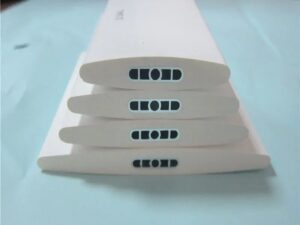
Questions 1 to 4 establish capability. For paulownia, question 2 separates a mill from a trader, because a trader cannot know the tolerance on a lot they did not make. For 3D mesh, question 4 does the same job: a factory rejects material, and the reason is usually specific enough to be checkable.
Questions 5 to 8 establish candour. A supplier who claims no rejects, no difficult parameters and no late deliveries is either new or not answering. The useful answers are specific and slightly unflattering.
Questions 9 to 12 establish alignment. Subcontracting is normal; hiding it is not. A supplier who names the outsourced operations has given you a map of where the risk sits.
Scoring
| Dimension | Weight | A 5 looks like | A 1 looks like | Process knowledge | 30 % | Names the parameter they struggle with | Describes the product from a catalogue | Traceability | 25 % | Lot number on every report | Reports on request, undated | Candour | 20 % | Admits rejects and subcontracting | No rejects, everything in-house | Responsiveness | 15 % | Answers within a day, with data | Answers fast, with reassurance | Commercial clarity | 10 % | States what is excluded | Quotes a single number |
|---|

The second-order test
A first order tests the sales process; a second tests the system. Between them, check four things: whether the lab dip arrived on the day promised, whether the report carried the lot number, whether the packing matched the agreement, and whether anyone told you about a problem before you found it. The last one is the best single indicator of a supplier you can plan around.
Six answers that should worry you
| What they say | What it often means | What to ask next | ‘We never have rejects.’ | Either new, or not measuring | Ask what the last rejection was and why | ‘Any tolerance you need.’ | No process control | Ask what they hold on their own standard | ‘Same lead time for any quantity.’ | No scheduling model | Ask what changes at triple the volume | ‘Certificate covers everything.’ | Scope is unclear | Ask for the scope, site and date | ‘We do everything in-house.’ | Subcontracting hidden | Ask to see the specific operation | ‘Price is fixed for the year.’ | Raw material risk is priced in | Ask what happens if resin moves 15 % |
|---|
This table is not a scoring system. It is a set of follow-up questions, because the first answer in each row is the one that sounds best and reveals least.
Related detail for supplier selection
Family specifications start from the fabric overview or the wooden blinds overview. Our documentation and testing regime is on the quality control page, and commercial terms are on the logistics page.
Questions buyers ask before ordering
What happens to supplier guide if we need tolerance tighter than 2.5-3.2 mm?
On supplier guide, 2.5-3.2 mm applies to the roll as delivered.
Is 2.5-3.2 mm a limit or a typical value for supplier guide?
On supplier guide, we hold 2.5-3.2 mm.
Supplier selection: the same question, asked of shutters
The two lines fail differently, so the wording that protects you differs too. On shutters the recurring modes are these, caught with a different test.
| Failure | What triggers it | Test to demand on the production lot | shutters: Hinge pull-out | Thin frame section or the wrong screw for the material. | Moisture content (wood) — meter; acceptance 8-12 % | shutters: Paint bridging | Paint applied after assembly without clearing the gaps. | Squareness — diagonal; acceptance <= 2 mm |
|---|
Four checks that remove a supplier before the sample
Most supplier failures are visible before a sample is made. These four checks take an afternoon and remove the ones that will not survive a repeat order.
- Export records, not export claims. Ask for three bills of lading from the last twelve months, destination and product visible. A supplier who exports to the market you are selling into has already met its import rules.
- Machine list with counts. “We have looms” is not a list. Twenty looms and one stenter is a different supplier from four looms and three stenters, and the second one cannot hold a delivery date on a large order.
- Who else they make for. Not names — categories. A mill that already supplies bag fabric understands abrasion; one that supplies lining does not, and will quote anyway.
- Who answers technical questions. If every question routes through a salesperson and comes back a day later, the technical person is not in the loop, and the specification will be interpreted by whoever is cheapest to ask.
None of this replaces an audit. It replaces the three audits you would otherwise run on suppliers who were never going to pass.
The strongest single signal is a supplier who answers a technical question with a number and a standard, then says which part of your specification they would change. That is a supplier who has read it.
A scorecard with weights, so the decision is repeatable
| Criterion | Weight | What is measured | Score 1-5 |
|---|---|---|---|
| Quality record | 30 % | Three consecutive lots inside the AQL band, with the reports | 5 = three lots, zero rejects |
| Price at volume | 25 % | Per metre at 3 000 m, ex-works, with the tolerance clause included | 5 = lowest of four, same clause |
| Lead time and reliability | 20 % | Quoted days against the last six shipments | 5 = quoted date met six times |
| Capacity headroom | 15 % | Monthly capacity less current bookings | 5 = 40 % free for your forecast |
| Compliance file | 10 % | Dated test reports, EU responsible person, EPR numbers | 5 = complete and current |
Weighting quality at 30 % is a decision, not a default. On a commodity line price can carry 40 %; on anything with a claim history it cannot, because the cost of one rejected container is larger than the difference between the first and fourth quote. Write the weights down before the quotes arrive, or the scorecard becomes a justification for the supplier the buyer already preferred.
Working a sourcing decision through?
Describe the end use and the failure you are designing out. We reply with the material we would specify, the figure that decides it, and the test that proves it.
What a video audit can prove
That the machine exists, that it is running the material you are buying, and that the person answering your questions is on the floor. Those three facts eliminate most trading companies.
It can also show housekeeping, storage conditions and how material is handled between processes, which are better predictors of defects than most certificates.
What it cannot prove
Capacity, financial stability, labour conditions and what happens on a bad day. A video is a snapshot chosen by the supplier, even when it is unscripted.
It also cannot verify subcontracting unless you ask to see the specific operation and follow the material through it.
How to request one without it being staged
Ask for a live call rather than a recording, at a time you choose, and ask to see a specific machine running your material. Ask the operator a question directly.
Ask to see the warehouse and the packing area, not only the production line. Those are the areas a staged tour skips and the areas where damage and mix-ups happen.
When on-site is worth the cost
First order above a threshold, any order with a safety component, and any supplier you intend to rely On more than a season. The cost of a visit is usually less than one failed container.
If you cannot travel, a third-party audit with a photographic report is the middle option, and it is more rigorous than a video because the auditor is not chosen by the supplier.
Products in this range
Related reading
- Landed Cost for Importers: The Six Lines Buyers Forget
- Shipping Textile and Window Covering from China: Container Maths, Packaging and Damage Control
- Non-Woven Fabric Guide: Spunbond, Spunlace and What GSM Really Tells You
Sample cut with your values on it · Neutral packing and private label · Consolidation, documents and lead times