A free sample is never free. Someone pays for the material, the setup, the courier and the time, and knowing which one your supplier is absorbing tells you what kind of relationship you are starting.
The four costs inside a sample
Material, setup, labour and freight. On a custom colour, the setup usually exceeds the material. On a stock item, the material dominates. Courier is almost always the smallest line and the one buyers argue about most.
When a supplier offers a free custom sample, they are underwriting the setup. That is a real investment and it usually comes with an expectation of volume. It is fair, but it should be stated.
Why some suppliers charge and others do not
A factory with in-house sampling can absorb the cost more easily than a trader who buys samples from a third party. A charge is not a red flag; an unexplained free sample from a trader often means the sample is not from the production line.
The useful question is not ‘is it free’ but ‘is this sample from the line that will make my order’.
The sample that costs you the order
A development sample that outperforms production is the most expensive sample a buyer can receive. It passes every test, the order is placed, and the first lot fails.
Ask for the sample to be drawn from a production run, with the lot number on the label. If the product is new, ask for a pre-production sample and treat the first lot as a separate approval.

A sample policy that works
Pay the courier, ask for the sample to be production material, keep one sealed unit as the retained standard, and record the date and lot. That combination costs very little and prevents most of the disputes that follow.
On approval, ask whether the sample charge is credited against the first order. Most factories will agree, and the ones that will not are telling you something about how they handle small amounts.
The sample request that gets a useful answer
Ask for three things in one message: a sample in the exact construction you intend to order, drawn from a production run with the lot number on the label, and the test report for that lot. A supplier who can send all three is a supplier with a production line and a quality function.
If the construction does not exist yet, ask for a development sample and label the first production lot as a separate approval. That is the honest route, and it prevents the most expensive mistake in sampling: treating a development sample as evidence of production performance.

Budgeting for samples
Allow for the sample cost, the courier, and the time. The courier is usually the smallest line and the one that gets negotiated hardest, which is a poor use of attention. The time is the line that matters: two rounds of sampling at ten days each is three weeks of the calendar, and that is the number to put in the launch plan.
Courier, customs and the paperwork nobody mentions
A sample shipment is an export like any other. It needs a commercial invoice, a declared value and, for some destinations, a certificate. Declaring a sample as a gift to avoid duty is common and it is also the reason samples get held, which costs more time than the duty would have.
Declare the material value honestly, use the supplier’s courier account where possible, and ask for the tracking number the same day. A sample that arrives three weeks late has already cost you the decision window.
What to do when the sample is right and the first lot is not
Compare the two against the retained standard, then check the lot number and the production date. If the sample was development material, the difference is expected and the fault is in the approval process. If the sample was production material, the fault is in the supplier’s process control, and that is a different conversation with a different remedy.
| Cost line | Who usually pays | What to check | Material and setup | Supplier, on a stock item | Whether the sample is production material | Custom colour setup | Buyer, or credited against the order | Whether the credit is written down | Labour | Supplier | Whether the sample came from the line | Courier | Buyer | Declared value and paperwork | Your time | Buyer | Two rounds of sampling is three weeks |
|---|
Related detail: how we document quality is on the quality control page , our commercial terms are on the logistics page , and specification ranges for both product lines start from the fabric and wooden blinds overviews.
Questions buyers ask before ordering
What is the actual tolerance behind sample policy real cost?
On sample policy real cost, it depends on 3-15 mm and on the end use.
Can you hold tolerance at 3-15 mm for sample policy real cost on a repeat order?
On sample policy real cost, not below 3-15 mm without a surcharge: the beam setup time does not shrink with the order, so small volumes carry the same setup.
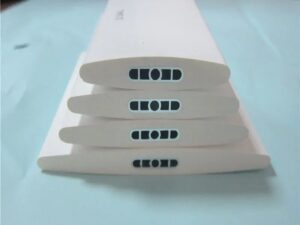
The PVC slat question, priced into sampling
What a sample costs both sides
A free sample is not free. It is priced into the quotation, usually at 3-5 %, and it is the reason two suppliers quoting the same material differ by exactly that amount.
- The sample itself. A stock sample costs a courier fee. A development sample costs a dye bath, a loom setup and a week of the technical team’s time — several hundred dollars before anything ships.
- The courier. A 2 kg parcel from China to Europe is 60-120 USD depending on speed. Ten sample rounds is a thousand dollars that never appears on a purchase order.
- The sample order. A 50 m trial is priced at sample rates, often double the bulk price per metre, and that premium is the setup cost being recovered.
- The credit. Many suppliers deduct the sample cost from the first bulk order. Ask whether they do, and get it in writing before paying.
The buyers who get fast samples are the ones who send a complete specification with the request. A sample made against a clear spec can be produced from stock; one made against a paragraph requires a development run, and the queue reflects it.
Budget the sample stage explicitly — 500 to 1 500 USD for a new material — and it stops being a surprise in the margin.
What a sample round costs, line by line
- Sample fee, 30-80 USD per piece. It covers the cutting and the machine time, not the material. Factories waive it on the first order and invoice it on every round after that.
- Courier, 40-90 USD per shipment. A 2 kg parcel from Zhejiang to a European address sits at the top of that band; consolidating two rounds into one shipment halves the cost and adds a week.
- Three rounds, 2-4 weeks each. The first sample proves the construction, the second proves the colour, the third proves the production line. Anything shorter than three rounds is a sample policy that has not met a factory yet.
- Your own time, 4-6 hours per round. Measuring, photographing, writing the comment sheet, and the email that explains why round two is rejected. This is the line that never appears in the budget.
- The cost of approving too early. One container of 3 000 pieces at 4 USD landed, rejected at 30 % defect rate, is 3 600 USD of goods plus the sorting, and the sample that was approved in week two is the reason.
Add the four lines and a three-round sampling programme on a single product lands between 400 and 900 USD before a purchase order exists. The number that makes it cheap is not the sample fee. It is the cost of the first container that ships because nobody asked for round three.
The sample budget, in round numbers
| Line | Amount | Notes |
|---|---|---|
| Sample fees, 3 rounds x 2 pieces | 180-480 USD | 30-80 USD per piece, waived on the first order only |
| Courier, 3 shipments | 120-270 USD | 40-90 USD each; air freight is 3-5 days, sea is not an option |
| Counter-samples from your own line | 60-150 USD | Sewn in the target fabric so the factory compares like with like |
| Total before any PO exists | 400-900 USD | Against a first container of 3 000 pieces at 4 USD landed |
Round three is where most programmes stop early, and it is the cheapest round to run: one piece, 14 days, an 80 USD courier bill, and about 6 hours of comparison against the approved bulk. Skipping it saves 100 USD and exposes a first container of 3 000 pieces at 4 USD landed, 12 000 USD of goods, to a 30 % reject rate that the sample would have shown in week two. The recovery, if it goes wrong, is 300-800 USD of sorting and a 4-6 week replacement lead time. Budget the programme at 2 pieces per round, 21 days of calendar and 5 % of the order value, against a 3-round budget of 400-900 USD, and it stops being a surprise. Count 2-4 weeks per round and 6-8 weeks from first sample to approval.
Need sample policy real cost checked against your end use?
For sample policy real cost, send 3-15 mm with quantity and destination market; the reply states the band we hold, the price at that volume and the test report.
Related reading
Sample cut with your values on it · Neutral packing and private label · Consolidation, documents and lead times