Salt air and humidity attack metal hardware before they attack the slat. The hardware spec is the one that matters.
The requirement is salt air and humidity, and they attack the hardware before the slat. Stainless or coated components are the specification, not an upgrade.
The second is UV. A coastal window receives reflected light from water, which raises the exposure above what an inland specification assumes, and it is the reason white PVC yellows faster at the coast.
Requirements for coastal and humid projects
- PVC slats: UV stabiliser at required, stated in phr — Without it, white goes yellow and colours fade within a season outdoors.
- finished blinds: Ladder tape / cord at polyester, 12-25 mm — Tape width affects the visual and the cord friction.
- basswood: Moisture content at 8-12 % — The single most important number. Outside this band the slats bow inside one season, and coastal humidity does not give it back.
- Service life: Salt air and humidity attack metal hardware before they attack the slat. The hardware spec is the one that matters.
- Destination: the compliance regime changes the construction, not only the paperwork, so confirm the market before the sample is approved.
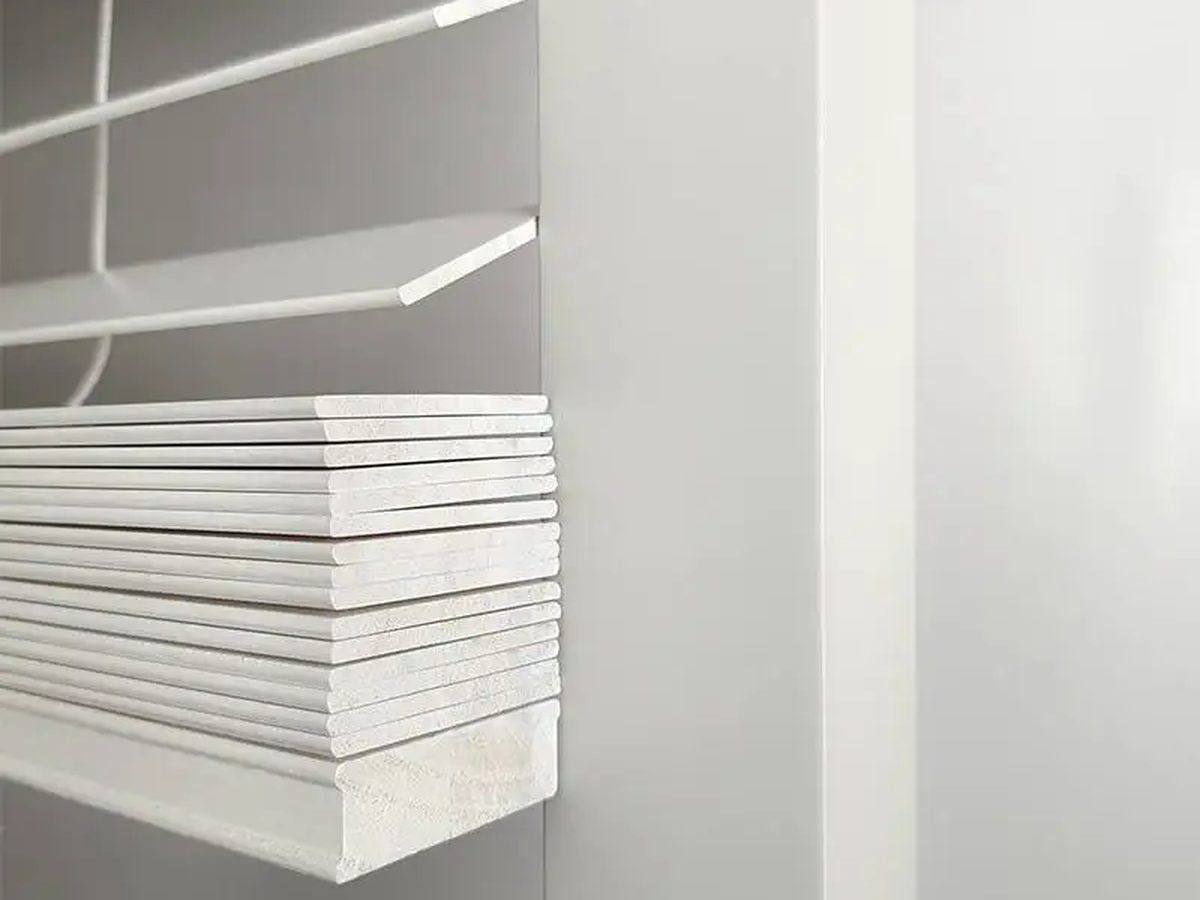
Candidate materials for coastal and humid projects, and where each one loses
| Material | Decisive parameter | Characteristic failure | PVC slats | UV stabiliser: required, stated in phr | Yellowing | finished blinds | Ladder tape / cord: polyester, 12-25 mm | Cord lock slipping | basswood | Moisture content: 8-12 % | Warping and bowing | motorised blinds | Noise: <= 35 dB at 1 m | Motor stall on wide blinds |
|---|
A specification you can send for coastal and humid projects
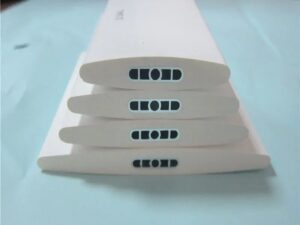
Pvc Slats
Finished Blinds
Basswood
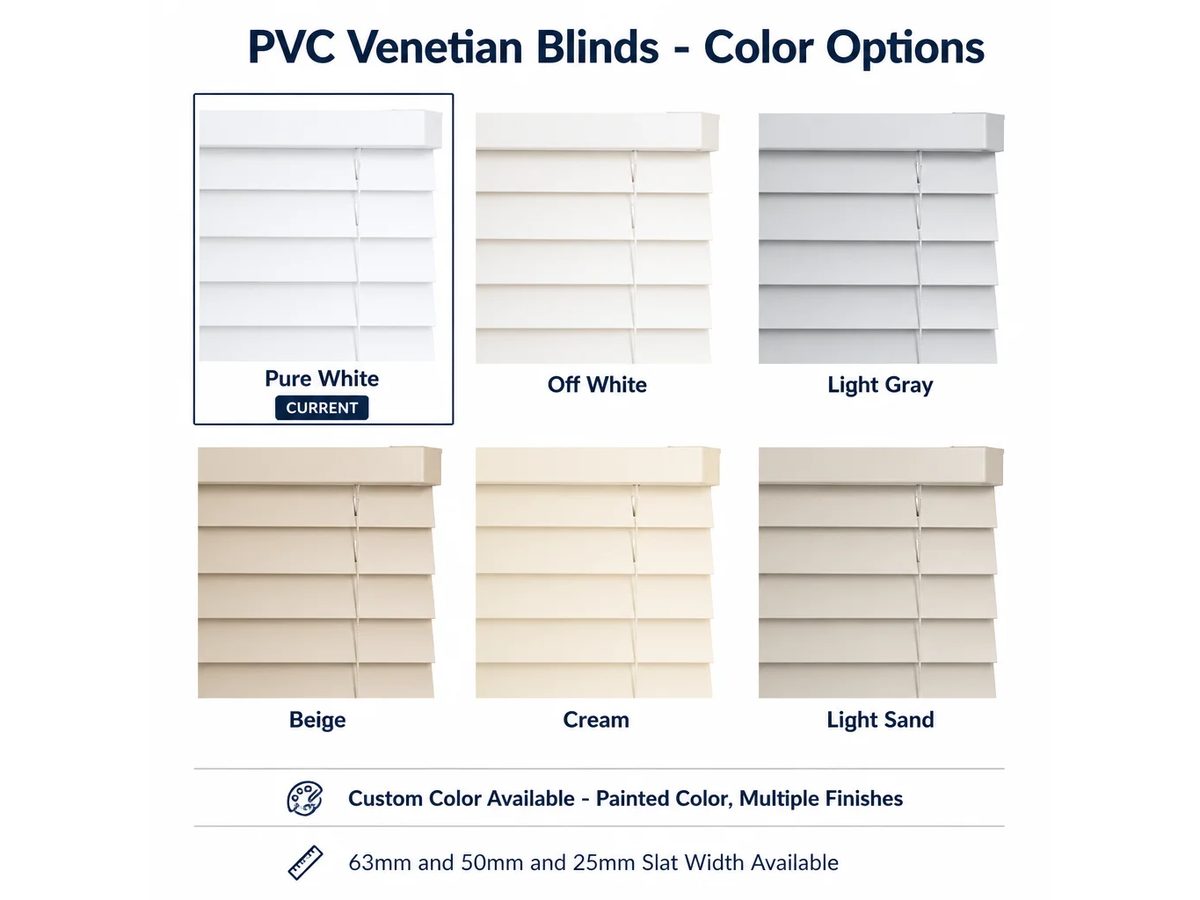
Sourcing notes for coastal and humid projects
- Ask for samples in the exact construction. For PVC slats that means slat width at 25 / 35 / 50 mm, not the nearest stock line.
- Run the sample through the process your factory will use: moisture stability.
- Confirm the destination market; REACH and 16 CFR 1120 both change the finish rather than the substrate.
- Check the MOQ per colour: 500-800 sets per colour for PVC slats, 200-500 sets per size and colour for finished blinds.
Questions buyers ask before ordering
What is the actual tolerance behind for coastal humid?
On coastal humid, the value is 12-25 mm, and it holds for the fabric as specified.
Can you hold tolerance at 12-25 mm for coastal humid on a repeat order?
On coastal humid, that figure is 12-25 mm.
What the first sample for coastal and humid projects should prove
- That slat width sits inside 25 / 35 / 50 mm on production material, not on a development sample.
- That yellowing passes after the process your factory will use, not only in the laboratory condition.
- That the colour matches the approved standard under D65, on the actual PVC slats lot that will ship.
- That the packing and MOQ (500-800 sets per colour) match what the quotation assumed.
Sub-applications within coastal and humid projects, and what each one needs
| Sub-application | What dominates | Starting specification | Bathrooms and wet rooms | Moisture stability | 50 mm, 2.0 mm, white | Hotel guest rooms | Cycle life, safety, blackout options | 50 mm, branded lock, contract cord | Residential windows | Light control, warmth, child safety | 50 mm, 2.8 mm, cordless or tension device | Hotel guest rooms | Noise, reliability, central control | Battery, Zigbee, <= 30 dB, manual override |
|---|
Certification class for coastal and humid projects, by destination
| Market | What it usually changes | the EU | REACH — SVHC screening and azo dye limits; ask for the current candidate list check, not a generic certificate | the US | 16 CFR 1120 — corded window coverings are regulated; cordless or short-cord is the practical route | the UK | BS EN 13120 — mirrors the EU safety standard but is a separate declaration | Australia | Corded internal window coverings regulation — mandatory safety standard; cordless or tension device |
|---|
Failure patterns to test before committing to coastal and humid projects
PVC slats. Yellowing: White slats turn cream within a year in a sunny window. Cause: insufficient or wrong uv stabiliser; often tio2 grade rather than a true uv package. Test: QUV 300 h, measure dE and yellowing index.
Coastal and humid projects: failure modes worth a clause in the purchase order
Salt, humidity and the eighteen-month failure
Coastal installations fail in a fixed order, and the order is useful: it tells you what to upgrade first when the budget cannot cover everything.
- Month 1-3: the cord. Polyester cord absorbs moisture and stiffens; cheap cord locks corrode at the spring. This is the first complaint and the cheapest to prevent.
- Month 3-9: the finish. Water-based lacquer on a slat that was not equalised blisters at the end grain. The slat does not fail; the coating does.
- Month 9-18: the metal. Steel headrails show rust at the cut ends first, then at the rivets. Stainless hinges and aluminium headrails move this failure past the warranty.
- Month 12-24: the PVC. A slat without a stated UV stabiliser loading yellows on the seaward elevation before it fails anywhere else.
The specification that survives a coastal site names four things: a stainless or aluminium fixings pack, a marine-grade cord, an equalised slat at 8-12 % moisture content, and an UV stabiliser loading in phr for any PVC component.
Salt spray testing to ISO 9227 at 200 hours is the cheapest proof. Ask for it on the hardware, not on the slat, because the hardware is what fails.
The maintenance schedule to budget for
A coastal installation needs a schedule, and the schedule is part of the cost of ownership. Four interventions cover the first three years.
- Every 3 months: the cord and the lock. Wipe, check for stiffening, check the lock spring. This is a two-minute task that prevents the first complaint.
- Every 6 months: the fixings. Look for white corrosion at the brackets and rivets. Catching it at six months means a screw; at eighteen months it means a blind.
- Every 12 months: the slat ends. End grain is where moisture enters and coating lifts. A touch-up pen at year one extends the finish past year five.
- Every 24 months: the operating test. Full travel, both directions, at the widest window. Stiffness here predicts a failure before it becomes a call-out.
Budget the schedule as a percentage of the installation — 1-2 % a year is realistic for a coastal site and near zero inland. Selling the schedule with the blinds is easier than selling it after the first failure.
Keep one spare of each component on site. The cost of a bracket is trivial; the cost of a site visit to fit it is not.
The coastal file: salt, humidity and eighteen months
- Salt spray to ASTM B117, with 500 hours as the floor for hardware that faces the sea and 200 hours for a sheltered elevation.
- Humidity cycling at 60-90 % RH and 40 C, which is the condition that separates a stabilised PVC from a filled one.
- Stainless grade 304 for coastal, 316 where salt is visible on the glass; a zinc-plated chain is a one-season component.
- Coating on timber at three coats rather than two, because the third coat is the one that closes the end grain.
- Colour shift at Delta E <= 3 after 2 000 hours QUV, which is the figure a warranty should be written against.
Coastal failures are chemical, not mechanical. Nothing breaks; the surface changes colour, the stabiliser migrates out, and the hardware seizes at the pivot.
Need a quotation you can compare line by line?
Send the material, the annual volume and the destination market. The reply names the parameters we would fix first, the tolerance we hold, and the documents that ship with the lot.
Products in this range
Related reading
- Pvc Slats vs Basswood: Which One Fits Your Programme
- How to Compare Supplier Quotes That Look Nothing Alike
- Bags Fabric Sourcing: 600D vs 1680D, Coating and Seam Failure
Catalogue and current price list · Neutral packing and private label · Consolidation, documents and lead times